 Alysa Segovia
 What to Wear to a Mountain Elopement: A Practical Style Guide
Mountain elopement attire guide — fabrics that work on trails, hiking boots under a dress, colors that photograph beautifully in the Blue Ridge, and how to layer for Shenandoah's weather.
Here’s what nobody tells you about mountain elopement attire: it’s mostly common sense, but common sense is easy to forget when you’re in full wedding planning mode and looking at gorgeous photos of people in impractical things.
Here’s the honest guide — because the goal is photos that look beautiful and a day where you’re comfortable, warm, and not face-planting on a rocky trail in stilettos.
The golden rule of mountain elopement attire
Dress for the adventure first. The photos will follow.
A bride who is comfortable, warm, and not anxious about her dress dragging through mud looks radiant in photographs. A bride who is cold, uncertain on rocky terrain, and worried about her dress is harder to photograph — not because of skill, but because real joy is harder to access when you’re uncomfortable.
Start with what makes you feel like yourself, then refine for the practical realities of your specific location.
Dress fabrics that work beautifully outdoors
Yes to:
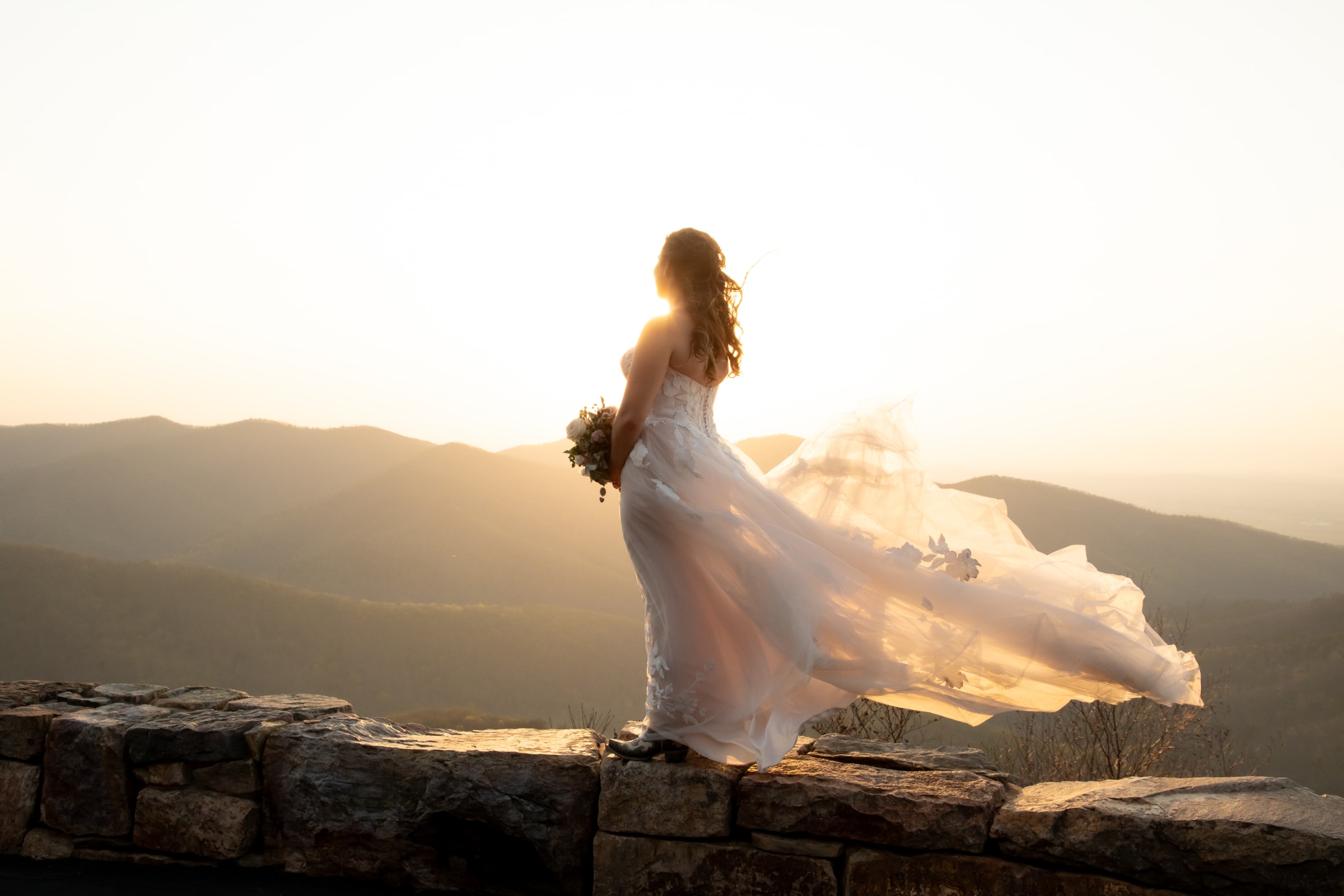
- Chiffon — flows beautifully in mountain breezes, photographs with incredible movement, lightweight for hiking
- Lace — catches light gorgeously in the outdoors, especially in dappled forest light
- Organza — delicate but photographs well, adds some structure without weight
- Lightweight satin — can work if not too heavy; prone to showing wrinkles but often worth it
- Jersey knit — practical, comfortable, and stretchy for actually moving. Don’t underestimate this option for a hiking-forward elopement.
Be cautious with:
- Heavy structured fabrics — ball gown skirts with boning were not designed for trail hiking
- Very long trains — beautiful in photographs, challenging on rocky terrain, prone to mud
- Bright, stark white — can blow out in direct sunlight; ivory or cream is often more flattering and photographs more warmly
Shoes: the most important practical decision you’ll make
I’m going to say the word stilettos exactly once in this guide, and here it is: not on a mountain trail.
For most Shenandoah and Blue Ridge elopement locations, you have options:
Option 1: Hiking boots under the dress This is more common than you’d think, and it looks amazing. Sturdy lace-up hiking boots with a flowing dress is a look that says “I am an actual human who goes on adventures.” It photographs beautifully.
Option 2: Wedges or block heels For ceremony spots that are accessible without significant hiking (many Blue Ridge Parkway overlooks, for example), wedges or block heels work well. They provide some elevation while offering more stability than stilettos on uneven ground.
Option 3: Comfortable flats or sandals For couples who want the practical and the simple — sandals with good grip, or flats that you’d actually walk in — this works beautifully. Your shoes don’t have to be heels.
The two-shoe strategy: Bring the hiking boots for the hike in, carry your ceremony shoes, and do a quick swap at the ceremony location. A solid plan for locations like Stony Man Summit or Bearfence Mountain.
Colors that photograph beautifully against Virginia’s landscape
Virginia’s mountain landscape has a specific color palette: deep forest greens, grey-blue mountain ridges, golden autumn tones, blue sky, warm rock colors. Your attire will either harmonize with or contrast against this palette.
Colors that work especially well:
- Ivory and cream — warm, soft, and beautiful against every season
- Champagne and gold — particularly stunning in fall
- Sage green — harmonizes with the forest palette in a magical way
- Dusty rose and blush — soft and romantic against both mountain and forest settings
- Terracotta and rust — A pale, dusty version of this color (think muted clay or faded adobe) works beautifully in any season.
- Burgundy/wine — rich and dramatic against peak fall color
Colors to think carefully about:
- Bright white — can blow out in direct sunlight. Test with your photographer’s editing style in mind.
- Neon or very saturated colors — can look jarring against natural landscapes. Not impossible, but requires intention.
- Black — actually photographs beautifully in the right setting (particularly the quartzite at Blackrock Summit), but can read as dramatic rather than romantic depending on what you’re going for.
Layering for mountain weather: a season-by-season guide
Mountain temperatures at 3,000-4,000 feet are different from valley temperatures, often by 10-15 degrees Fahrenheit. Plan accordingly.
Spring:
- Morning temperatures can be in the 40s-50s even when the valley is warmer
- A light jacket or wrap for the hike in; remove for ceremony photos
- Shawl or wrap that photographs beautifully is perfect
Summer:
- Morning ceremonies can be surprisingly cool at elevation
- Afternoons are warm — be prepared to be comfortable in just your dress by noon
- Thunderstorms build in the afternoon; morning ceremonies are strongly recommended
Fall:
- This is the trickiest season for layering
- October mornings at Shenandoah can be in the 40s. Sometimes the 30s.
- A beautiful wool wrap or tailored coat that you can remove for ceremony photos is essential
- Don’t underestimate the cold on an October Shenandoah morning
Winter:
- Dress warmly. Seriously.
- This isn’t the season for a thin chiffon gown on a rocky summit
- Heavier fabrics, warm layers, and accepting that some of those layers might be in your photos
- Faux fur stoles look stunning in winter mountain settings and actually keep you warm
Practical items to bring
Regardless of what you’re wearing, pack these:
- Extra hair ties (mountain wind is real)
- Bobby pins
- A light layer that can be put on and taken off easily
- Blister pads if you’re breaking in new shoes
- Snacks (nobody wants to be hungry on their wedding day)
- A bag you don’t mind your photographer carrying or that fits in a pack
If you’re not wearing a dress
Everything above applies to suits and other attire too:
- Lighter-weight fabrics breathe better in summer
- Consider a vest instead of a full suit jacket for flexibility
- Dark navy and charcoal photograph beautifully against mountain backgrounds
- Earthy tones (olive, tan, camel) are stunning and unexpected
- Hiking boots under dress pants is absolutely a look you can pull off
- Dark jeans with a sports jacket works too — clean, relaxed, and great in photos
A final note
Couples who look most joyful in elopement photos tend to be the ones who dressed in a way that let them be fully present — not worrying about tripping, not cold, not anxious about their dress.
You can look absolutely stunning in a mountain setting in almost anything, as long as it’s genuinely you. The “best” elopement attire is the one you’re comfortable in, that feels like yourself, and that lets you focus on getting married rather than managing your outfit.
Want to bounce specific attire ideas around before you purchase anything? As your Virginia elopement photographer, I’m happy to help — feel free to reach out.
More elopement planning guides
Frequently Asked Questions
Can I wear a traditional wedding dress for a mountain elopement?
Yes, with the right fabric choices and some practical preparation. Flowing chiffon and lightweight lace can be absolutely gorgeous in mountain settings. The key is avoiding fabrics that are very structured, heavy, or that require dry cleaning only. And think carefully about your shoes.
Should I wear hiking boots for my mountain elopement?
For many mountain locations, yes — or at least bring them. At locations like Stony Man Summit or Bearfence Mountain in Shenandoah, the rocky terrain makes comfortable, sturdy footwear important for the hike in. Many brides wear hiking boots under their dress for the hike and switch at the ceremony.
What colors photograph best in the mountains?
Earth tones work beautifully — ivory, cream, champagne, sage green, dusty rose, pale terracotta, and warm neutrals all complement the Blue Ridge color palette. Bright white can blow out in direct sunlight. Very light pinks and blush photograph softly and warmly against mountain greens and blues.
What should I layer for a Shenandoah elopement?
Even in summer, mountain mornings can be cool. Bring a cardigan, light jacket, or wrap that can be removed for the ceremony. In fall, temperatures at 3,500 feet can be significantly colder than the valley. In winter, dress as warmly as you can while still feeling like yourself.
What about rain or unexpected weather?
Bring a trench coat or a wool wrap that photographs well. Rain doesn't have to ruin anything — some of the most dramatic mountain elopement photos happen in fog and rain. Have a plan, but don't let weather fear drive your attire choices.